Side Profile of a Businessman Walking Canvas Art 18 X 24
| Edward Hopper | |
|---|---|
 | |
| Born | (1882-07-22)July 22, 1882 Nyack, New York, U.S. |
| Died | May 15, 1967(1967-05-15) (aged 84) Manhattan, New York, U.S. |
| Known for | Painting |
| Notable work | Automat (1927) Chop Suey (1929) Nighthawks (1942) Office in a Small City (1953) |
| Movement | Realism |
| Spouse(s) | Josephine Nivison (k. 1924) |
Edward Hopper (July 22, 1882 – May 15, 1967) was an American realist painter and printmaker. While he is widely known for his oil paintings, he was equally skilful every bit a watercolorist and printmaker in carving. His career benefited decisively from his marriage to fellow-artist Josephine Nivison, who contributed much to his work, both as a life-model and as a creative partner. Hopper was a pocket-size-key artist, creating subdued drama out of commonplace subjects 'layered with a poetic meaning', inviting narrative interpretations, ofttimes unintended. He was praised for 'complete verity' in the America he portrayed.
Biography [edit]
Early life [edit]

Childhood dwelling of Edward Hopper in Nyack, New York
Hopper was born in 1882 in Nyack, New York, a yacht-building center on the Hudson River north of New York City.[1] [two] He was ane of two children of a comfortably well-off family. His parents, of more often than not Dutch beginnings, were Elizabeth Griffiths Smith and Garret Henry Hopper, a dry-goods merchant.[3] Although non as successful equally his forebears, Garrett provided well for his ii children with considerable help from his wife's inheritance. He retired at age forty-nine.[iv] Edward and his only sister Marion attended both private and public schools. They were raised in a strict Baptist home.[five] His begetter had a mild nature, and the household was dominated past women: Hopper'southward mother, grandmother, sis, and maid.[6]
His birthplace and boyhood home was listed on the National Annals of Celebrated Places in 2000. It is now operated as the Edward Hopper House Fine art Center.[7] Information technology serves as a nonprofit customs cultural center featuring exhibitions, workshops, lectures, performances, and special events.[8]

Vase (1893), case of Edward Hopper's primeval signed and dated artwork with attention to light and shadow.
Hopper was a good pupil in form schoolhouse and showed talent in drawing at historic period 5. He readily absorbed his father's intellectual tendencies and love of French and Russian cultures. He also demonstrated his female parent'southward artistic heritage.[nine] Hopper's parents encouraged his art and kept him amply supplied with materials, instructional magazines, and illustrated books. Hopper start began signing and dating his drawings at the age of x. The primeval of these drawings include charcoal sketches of geometric shapes, including a vase, bowl, cup and boxes.[ten] The detailed test of low-cal and shadow which carried on throughout the residue of his career tin can already exist plant in these early works.[ten] By his teens, he was working in pen-and-ink, charcoal, watercolor, and oil—drawing from nature every bit well equally making political cartoons.[11] In 1895, he created his start signed oil painting, Rowboat in Rocky Cove, which he copied from a reproduction in The Art Interchange, a popular journal for amateur artists. Hopper'south other earliest oils such as Old ice pond at Nyack and his c.1898 painting Ships have been identified as copies of paintings by artists including Bruce Crane and Edward Moran.[12] [13]
In his early self-portraits, Hopper tended to correspond himself as skinny, ungraceful, and homely. Though a tall and quiet teenager, his prankish sense of sense of humour constitute outlet in his fine art, sometimes in depictions of immigrants or of women dominating men in comic situations. Later in life, he generally depicted women equally the figures in his paintings.[14] In loftier school (he graduated from Nyack High Schoolhouse in 1899),[15] he dreamed of beingness a naval architect, only afterward graduation he declared his intention to follow an fine art career. Hopper's parents insisted that he study commercial art to have a reliable means of income.[16] In developing his self-epitome and individualistic philosophy of life, Hopper was influenced by the writings of Ralph Waldo Emerson. He later said, "I admire him greatly...I read him over and once more."[17]
Hopper began fine art studies with a correspondence course in 1899. Soon he transferred to the New York School of Art and Blueprint, the forerunner of Parsons The New School for Design. In that location he studied for six years, with teachers including William Merritt Chase, who instructed him in oil painting.[16] Early, Hopper modeled his mode later Chase and French Impressionist masters Édouard Manet and Edgar Degas.[18] Sketching from live models proved a claiming and a shock for the conservatively raised Hopper.
Another of his teachers, artist Robert Henri, taught life class. Henri encouraged his students to utilise their fine art to "make a stir in the globe". He too advised his students, "Information technology isn't the field of study that counts but what you feel most it" and "Forget well-nigh art and paint pictures of what interests you in life."[sixteen] In this manner, Henri influenced Hopper, also equally future artists George Bellows and Rockwell Kent. He encouraged them to imbue a modernistic spirit in their work. Some artists in Henri'southward circle, including John Sloan, became members of "The Eight", also known as the Ashcan School of American Art.[nineteen] Hopper'south first surviving oil painting to hint at his use of interiors equally a theme was Solitary Figure in a Theater (c.1904).[xx] During his educatee years, he also painted dozens of nudes, nonetheless life studies, landscapes, and portraits, including his self-portraits.[21]
In 1905, Hopper landed a part-time job with an ad bureau, where he created encompass designs for trade magazines.[22] Hopper came to detest illustration. He was bound to information technology by economic necessity until the mid-1920s.[23] He temporarily escaped by making 3 trips to Europe, each centered in Paris, ostensibly to study the fine art scene there. In fact, however, he studied alone and seemed by and large unaffected past the new currents in fine art. Later he said that he "didn't recall having heard of Picasso at all".[nineteen] He was highly impressed by Rembrandt, specially his Night Watch, which he said was "the virtually wonderful thing of his I have seen; it's by belief in its reality."[24]
Hopper began painting urban and architectural scenes in a dark palette. Then he shifted to the lighter palette of the Impressionists before returning to the darker palette with which he was comfortable. Hopper later said, "I got over that and afterward things done in Paris were more the kind of things I do now."[25] Hopper spent much of his time cartoon street and café scenes, and going to the theater and opera. Unlike many of his contemporaries who imitated the abstract cubist experiments, Hopper was attracted to realist art. Later, he admitted to no European influences other than French engraver Charles Meryon, whose moody Paris scenes Hopper imitated.[26]
Years of struggle [edit]
After returning from his final European trip, Hopper rented a studio in New York City, where he struggled to define his own way. Reluctantly, he returned to illustration to support himself. Being a freelancer, Hopper was forced to solicit for projects, and had to knock on the doors of magazine and agency offices to find business.[27] His painting languished: "information technology'due south hard for me to decide what I desire to pigment. I get for months without finding it sometimes. Information technology comes slowly."[28] His fellow illustrator Walter Tittle described Hopper'southward depressed emotional land in sharper terms, seeing his friend "suffering...from long periods of unconquerable inertia, sitting for days at a fourth dimension before his easel in helpless unhappiness, unable to enhance a hand to break the spell."[29]
In 1912 (February 22 to March 5) he was included in the exhibition of The Independents a grouping of artists at the initiative of Robert Henri just did not make any sales.[28]
In 1912, Hopper traveled to Gloucester, Massachusetts, to seek some inspiration and made his first outdoor paintings in America.[28] He painted Squam Light, the kickoff of many lighthouse paintings to come.[xxx]

Hopper's prizewinning poster, Boom the Hun (1919), reproduced on the front comprehend of the Morse Dry Dock Punch
In 1913, at the Armory Show, Hopper earned $250 when he sold his first painting, Sailing (1911), to an American businessman Thomas F Vietor, which he had painted over an earlier self-portrait.[31] Hopper was thirty-one, and although he hoped his first auction would pb to others in short order, his career would non catch on for many more years.[32] He connected to participate in grouping exhibitions at smaller venues, such every bit the MacDowell Gild of New York.[33] Shortly later on his begetter's death that aforementioned year, Hopper moved to the three Washington Square North apartment in the Greenwich Village section of Manhattan, where he would live for the rest of his life.

Night on the El Train (1918) by Edward Hopper
The following year he received a committee to create some movie posters and handle publicity for a movie company.[34] Although he did not like the illustration work, Hopper was a lifelong devotee of the picture palace and the theatre, both of which he treated as subjects for his paintings. Each form influenced his compositional methods.[35]
At an impasse over his oil paintings, in 1915 Hopper turned to carving. By 1923 he had produced nigh of his approximately 70 works in this medium, many of urban scenes of both Paris and New York.[36] [37] He also produced some posters for the war endeavour, equally well every bit continuing with occasional commercial projects.[38] When he could, Hopper did some outdoor oil paintings on visits to New England, especially at the art colonies at Ogunquit, and Monhegan Isle.[39]
During the early on 1920s his etchings began to receive public recognition. They expressed some of his later themes, as in Nighttime on the El Train (couples in silence), Evening Wind (solitary female person), and The Catboat (unproblematic nautical scene).[40] Two notable oil paintings of this time were New York Interior (1921) and New York Restaurant (1922).[41] He as well painted ii of his many "window" paintings to come: Girl at Sewing Automobile and Moonlight Interior, both of which evidence a effigy (clothed or nude) nigh a window of an flat viewed as gazing out or from the point of view from the outside looking in.[42]
Although these were frustrating years, Hopper gained some recognition. In 1918, Hopper was awarded the U.S. Shipping Board Prize for his war affiche, "Smash the Hun". He participated in three exhibitions: in 1917 with the Social club of Independent Artists, in Jan 1920 (a one-man exhibition at the Whitney Studio Social club, which was the precursor to the Whitney Museum), and in 1922 (again with the Whitney Studio Lodge). In 1923, Hopper received two awards for his etchings: the Logan Prize from the Chicago Lodge of Etchers, and the Westward. A. Bryan Prize.[43]
Marriage and breakthrough [edit]

Past 1923, Hopper's ho-hum climb finally produced a breakthrough. He re-encountered Josephine Nivison, an artist and former student of Robert Henri, during a summer painting trip in Gloucester, Massachusetts. They were opposites: she was brusque, open, gregarious, sociable, and liberal, while he was alpine, secretive, shy, quiet, introspective, and conservative.[38] They married a yr afterward with artist Guy Pene du Bois as their best man.[3] She remarked: "Sometimes talking to Eddie is but like dropping a stone in a well, except that it doesn't thump when it hits lesser."[44] She subordinated her career to his and shared his reclusive life style. The residual of their lives revolved around their spare walk-up apartment in the city and their summers in South Truro on Cape Cod. She managed his career and his interviews, was his primary model, and was his life companion.[44]
With Nivison's help, six of Hopper's Gloucester watercolors were admitted to an showroom at the Brooklyn Museum in 1923. I of them, The Mansard Roof, was purchased by the museum for its permanent drove for the sum of $100.[45] The critics generally raved about his work; one stated, "What vitality, force and directness! Observe what can exist done with the homeliest subject area."[45] Hopper sold all his watercolors at a one-human bear witness the following year and finally decided to put illustration behind him.
The artist had demonstrated his ability to transfer his attraction to Parisian compages to American urban and rural architecture. According to Boston Museum of Fine Arts curator Ballad Troyen, "Hopper actually liked the style these houses, with their turrets and towers and porches and mansard roofs and ornament cast wonderful shadows. He always said that his favorite thing was painting sunlight on the side of a firm."[46]
At 40-one, Hopper received further recognition for his work. He continued to harbor bitterness about his career, afterwards turning downwardly appearances and awards.[44] With his fiscal stability secured by steady sales, Hopper would live a simple, stable life and go on creating art in his personal style for four more than decades.
His Two on the Aisle (1927) sold for a personal tape $one,500, enabling Hopper to purchase an automobile, which he used to brand field trips to remote areas of New England.[47] In 1929, he produced Chop Suey and Railroad Sunset. The following year, fine art patron Stephen Clark donated House by the Railroad (1925) to the Museum of Mod Art, the first oil painting that information technology caused for its collection.[48] Hopper painted his last self-portrait in oil around 1930. Although Josephine posed for many of his paintings, she sat for but one formal oil portrait by her hubby, Jo Painting (1936).[49]
Hopper fared better than many other artists during the Great Low. His stature took a precipitous rise in 1931 when major museums, including the Whitney Museum of American Art and the Metropolitan Museum of Art, paid thousands of dollars for his works. He sold 30 paintings that year, including 13 watercolors.[47] The post-obit year he participated in the first Whitney Almanac, and he connected to exhibit in every annual at the museum for the balance of his life.[47] In 1933, the Museum of Modern Art gave Hopper his first big-scale retrospective.[l]
In 1930, the Hoppers rented a cottage in Due south Truro, on Cape Cod. They returned every summer for the rest of their lives, building a summer business firm there in 1934.[51] From there, they would take driving trips into other areas when Hopper needed to search for fresh textile to paint. In the summers of 1937 and 1938, the couple spent extended sojourns on Wagon Wheels Farm in South Royalton, Vermont, where Hopper painted a series of watercolors forth the White River. These scenes are atypical among Hopper's mature works, every bit virtually are "pure" landscapes, devoid of architecture or human being figures. Beginning Branch of the White River (1938), now in the Museum of Fine Arts, Boston, is the best-known of Hopper's Vermont landscapes.[52]
Hopper was very productive through the 1930s and early 1940s, producing among many important works New York Movie (1939), Girlie Show (1941), Nighthawks (1942), Hotel Lobby (1943), and Morning time in a City (1944). During the late 1940s, however, he suffered a period of relative inactivity. He admitted: "I wish I could pigment more. I get sick of reading and going to the movies."[53] During the next two decades, his wellness faltered, and he had several prostate surgeries and other medical bug.[53] But, in the 1950s and early on 1960s, he created several more major works, including First Row Orchestra (1951); as well as Morning Sun and Hotel by a Railroad, both in 1952; and Intermission in 1963.[54]
Death [edit]

Where Hopper lived in New York Urban center, 3 Washington Square North

Gravestone Edward and Josephine H., Oak Hill Cemetery, Nyack
Hopper died of natural causes in his studio near Washington Foursquare in New York Metropolis on May 15, 1967. He was buried two days later in the family plot at Oak Hill Cemetery in Nyack, New York, his place of nascence.[55] His married woman died 10 months subsequently and is buried with him.
His wife bequeathed their joint collection of more than than three m works to the Whitney Museum of American Art.[56] Other significant paintings by Hopper are held past the Museum of Modern Art in New York, The Des Moines Art Center, and the Art Institute of Chicago.
Fine art [edit]
Personality and vision [edit]
Always reluctant to discuss himself and his art, Hopper simply said, "The whole answer is in that location on the canvas."[l] Hopper was stoic and fatalistic—a quiet introverted man with a gentle sense of sense of humour and a frank manner. Hopper was someone fatigued to an allegorical, anti-narrative symbolism,[57] who "painted brusk isolated moments of configuration, saturated with suggestion".[58] His silent spaces and uneasy encounters "touch us where we are near vulnerable",[59] and have "a proposition of melancholy, that melancholy being enacted".[60] His sense of color revealed him every bit a pure painter[61] every bit he "turned the Puritan into the purist, in his repose canvasses where blemishes and blessings balance".[62] According to critic Lloyd Goodrich, he was "an eminently native painter, who more than whatsoever other was getting more of the quality of America into his canvases".[63] [64]
Conservative in politics and social matters (Hopper asserted for example that "artists' lives should be written by people very close to them"),[65] he accepted things as they were and displayed a lack of idealism. Cultured and sophisticated, he was well-read, and many of his paintings show figures reading.[66] He was mostly skilful company and unperturbed by silences, though sometimes taciturn, grumpy, or detached. He was always serious nearly his fine art and the fine art of others, and when asked would return frank opinions.[67]
Hopper'due south near systematic declaration of his philosophy as an artist was given in a handwritten annotation, entitled "Statement", submitted in 1953 to the journal, Reality:
Great art is the outward expression of an inner life in the artist, and this inner life volition result in his personal vision of the world. No amount of skillful invention tin can supervene upon the essential element of imagination. One of the weaknesses of much abstract painting is the endeavor to substitute the inventions of the human intellect for a individual imaginative conception.
The inner life of a man beingness is a vast and varied realm and does not business organization itself alone with stimulating arrangements of color, course and pattern.
The term life used in art is something not to be held in contempt, for it implies all of existence and the province of art is to react to information technology and not to shun it.
Painting will take to deal more fully and less obliquely with life and nature'southward phenomena earlier it tin can once more become great.[68]
Though Hopper claimed that he didn't consciously embed psychological meaning in his paintings, he was deeply interested in Freud and the power of the hidden mind. He wrote in 1939, "So much of every art is an expression of the subconscious that information technology seems to me nearly of all the important qualities are put in that location unconsciously, and little of importance past the conscious intellect."[69]
Methods [edit]
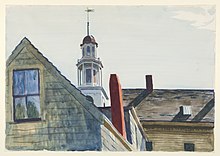
Although he is best known for his oil paintings, Hopper initially achieved recognition for his watercolors and he too produced some commercially successful etchings. Additionally, his notebooks contain high-quality pen and pencil sketches, which were never meant for public viewing.
Hopper paid item attention to geometrical pattern and the careful placement of man figures in proper residuum with their surroundings. He was a slow and methodical artist; equally he wrote, "Information technology takes a long time for an idea to strike. And so I have to recall nearly it for a long time. I don't start painting until I accept it all worked out in my mind. I'one thousand all correct when I get to the easel".[70] He ofttimes fabricated preparatory sketches to piece of work out his carefully calculated compositions. He and his wife kept a detailed ledger of their works noting such items every bit "lamentable face of adult female unlit", "electric calorie-free from ceiling", and "thighs cooler".[71]
For New York Motion-picture show (1939), Hopper demonstrates his thorough preparation with more 53 sketches of the theater interior and the figure of the pensive usherette.[72]
The effective apply of light and shadow to create mood likewise is primal to Hopper'south methods. Bright sunlight (as an emblem of insight or revelation), and the shadows it casts, also play symbolically powerful roles in Hopper paintings such as Early Sunday Morning time (1930), Summertime (1943), Seven A.M. (1948), and Lord's day in an Empty Room (1963). His use of light and shadow effects have been compared to the cinematography of film noir.[73]
Although a realist painter, Hopper's "soft" realism simplified shapes and details. He used saturated color to raise contrast and create mood.
Subjects and themes [edit]
Hopper derived his subject area affair from 2 main sources: 1, the common features of American life (gas stations, motels, restaurants, theaters, railroads, and street scenes) and its inhabitants; and two, seascapes and rural landscapes. Regarding his style, Hopper defined himself as "an amalgam of many races" and not a member of whatsoever school, especially the "Ashcan Schoolhouse".[74] Once Hopper achieved his mature style, his art remained consistent and self-independent, in spite of the numerous art trends that came and went during his long career.[74]
Hopper's seascapes fall into three main groups: pure landscapes of rocks, bounding main, and beach grass; lighthouses and farmhouses; and sailboats. Sometimes he combined these elements. Most of these paintings describe strong lite and fair weather; he showed little involvement in snowfall or rain scenes, or in seasonal color changes. He painted the majority of the pure seascapes in the period between 1916 and 1919 on Monhegan Island.[75] Hopper'south The Long Leg (1935) is a about all-blueish sailing motion-picture show with the simplest of elements, while his Ground Swell (1939) is more complex and depicts a group of youngsters out for a sail, a theme reminiscent of Winslow Homer'due south iconic Breezing Upward (1876).[76]
Urban compages and cityscapes likewise were major subjects for Hopper. He was fascinated with the American urban scene, "our native architecture with its hideous beauty, its fantastic roofs, pseudo-gothic, French Mansard, Colonial, mongrel or what not, with eye-searing color or frail harmonies of faded pigment, shouldering one another along interminable streets that taper off into swamps or dump heaps."[77]
In 1925, he produced House by the Railroad. This classic work depicts an isolated Victorian forest mansion, partly obscured by the raised embankment of a railroad. It marked Hopper'due south artistic maturity. Lloyd Goodrich praised the work as "ane of the almost poignant and desolating pieces of realism."[78] The piece of work is the showtime of a series of stark rural and urban scenes that uses sharp lines and large shapes, played upon by unusual lighting to capture the lone mood of his subjects. Although critics and viewers interpret meaning and mood in these cityscapes, Hopper insisted "I was more than interested in the sunlight on the buildings and on the figures than whatever symbolism."[79] As if to prove the point, his late painting Sun in an Empty Room (1963) is a pure study of sunlight.[lxxx]
Virtually of Hopper's figure paintings focus on the subtle interaction of human beings with their environment—carried out with solo figures, couples, or groups. His chief emotional themes are solitude, loneliness, regret, boredom, and resignation. He expresses the emotions in various environments, including the part, in public places, in apartments, on the route, or on vacation.[81] As if he were creating stills for a picture or tableaux in a play, Hopper positioned his characters every bit if they were captured just before or only later on the climax of a scene.[82]
Hopper'due south lone figures are mostly women—dressed, semi-clad, and nude—often reading or looking out a window, or in the workplace. In the early 1920s, Hopper painted his offset such images Girl at Sewing Machine (1921), New York Interior (another woman sewing) (1921), and Moonlight Interior (a nude getting into bed) (1923). Automat (1927) and Hotel Room (1931), nevertheless, are more than representative of his mature style, emphasizing the solitude more overtly.[83]
As Hopper scholar, Gail Levin, wrote of Hotel Room:
The spare vertical and diagonal bands of color and sharp electric shadows create a concise and intense drama in the night...Combining poignant subject matter with such a powerful formal arrangement, Hopper'due south composition is pure plenty to arroyo an nearly abstruse sensibility, yet layered with a poetic meaning for the observer.[84]
Hopper's Room in New York (1932) and Greatcoat Cod Evening (1939) are prime examples of his "couple" paintings. In the kickoff, a young couple appear alienated and uncommunicative—he reading the paper while she idles by the piano. The viewer takes on the role of a voyeur, equally if looking with a telescope through the window of the apartment to spy on the couple'southward lack of intimacy. In the latter painting, an older couple with little to say to each other, are playing with their canis familiaris, whose own attention is drawn away from his masters.[85] Hopper takes the couple theme to a more ambitious level with Circuit into Philosophy (1959). A middle-aged man sits dejectedly on the border of a bed. Beside him lies an open volume and a partially clad woman. A shaft of calorie-free illuminates the floor in front of him. Jo Hopper noted in their log volume, "[T]he open book is Plato, reread too tardily".
Levin interprets the painting:
Plato's philosopher, in search of the real and the true, must plow abroad from this transitory realm and contemplate the eternal Forms and Ideas. The pensive homo in Hopper's painting is positioned between the lure of the earthly domain, figured by the woman, and the phone call of the higher spiritual domain, represented by the ethereal lightfall. The pain of thinking about this option and its consequences, after reading Plato all night, is evident. He is paralysed by the fervent inner labour of the melancholic.[86]
In Office at Night (1940), another "couple" painting, Hopper creates a psychological puzzle. The painting shows a man focusing on his piece of work papers, while nearby his bonny female secretary pulls a file. Several studies for the painting show how Hopper experimented with the positioning of the ii figures, perhaps to heighten the eroticism and the tension. Hopper presents the viewer with the possibilities that the human being is either truly uninterested in the adult female's appeal or that he is working hard to ignore her. Another interesting aspect of the painting is how Hopper employs three light sources,[85] from a desk-bound lamp, through a window and indirect lite from higher up. Hopper went on to make several "office" pictures, just no others with a sensual undercurrent.
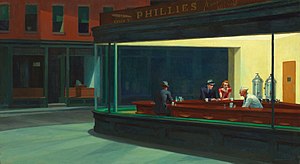

The best known of Hopper's paintings, Nighthawks (1942), is one of his paintings of groups. It shows customers sitting at the counter of an all-night diner. The shapes and diagonals are advisedly constructed. The viewpoint is cinematic—from the sidewalk, as if the viewer were approaching the eatery. The diner'due south harsh electrical light sets it apart from the dark night outside, enhancing the mood and subtle emotion.[87] Equally in many Hopper paintings, the interaction is minimal. The restaurant depicted was inspired by one in Greenwich Hamlet. Both Hopper and his wife posed for the figures, and Jo Hopper gave the painting its title. The inspiration for the picture may have come up from Ernest Hemingway'south short story "The Killers", which Hopper greatly admired,[88] or from the more than philosophical "A Clean, Well-Lighted Place".[89] The mood of the painting has sometimes been interpreted as an expression of wartime anxiety.[90] In keeping with the title of his painting, Hopper later said, Nighthawks has more to do with the possibility of predators in the night than with loneliness.[91]
His second most recognizable painting after Nighthawks is some other urban painting, Early Sunday Forenoon (originally chosen Seventh Artery Shops), which shows an empty street scene in sharp side light, with a fire hydrant and a barber pole equally stand up-ins for human figures. Originally Hopper intended to put figures in the upstairs windows but left them empty to heighten the feeling of pathos.[92]
Hopper's rural New England scenes, such as Gas (1940), are no less meaningful. Gas represents "a dissimilar, equally clean, well-lighted refuge ... ke[pt] open for those in demand as they navigate the dark, traveling their own miles to become earlier they sleep."[93] The work presents a fusion of several Hopper themes: the solitary figure, the melancholy of dusk, and the lone route.[94]
Hopper approaches Surrealism with Rooms past the Body of water (1951), where an open door gives a view of the bounding main, without an apparent ladder or steps and no indication of a beach.[95]
Afterward his educatee years, Hopper's nudes were all women. Unlike past artists who painted the female nude to glorify the female person form and to highlight female person eroticism, Hopper'southward nudes are solitary women who are psychologically exposed.[96] Ane adventurous exception is Girlie Bear witness (1941), where a red-headed strip-tease queen strides confidently across a phase to the accompaniment of the musicians in the pit. Girlie Evidence was inspired by Hopper'south visit to a burlesque show a few days before. Hopper'south wife, as usual, posed for him for the painting, and noted in her diary, "Ed showtime a new canvas—a burlesque queen doing a strip tease—and I posing without a stitch on in front end of the stove—cypher just high heels in a lottery dance pose."[97]
Hopper'south portraits and self-portraits were relatively few after his educatee years.[98] Hopper did produce a commissioned "portrait" of a house, The MacArthurs' Home (1939), where he faithfully details the Victorian compages of the domicile of extra Helen Hayes. She reported later, "I judge I never met a more than misanthropic, grumpy individual in my life." Hopper grumbled throughout the projection and never again accepted a committee.[99] Hopper also painted Portrait of Orleans (1950), a "portrait" of the Cape Cod town from its master street.[100]
Though very interested in the American Civil State of war and Mathew Brady's battlefield photographs, Hopper fabricated just ii historical paintings. Both depicted soldiers on their manner to Gettysburg.[101] As well rare among his themes are paintings showing action. The best instance of an action painting is Bridle Path (1939), just Hopper's struggle with the proper anatomy of the horses may have discouraged him from like attempts.[102]
Hopper'due south final oil painting, Ii Comedians (1966), painted one year before his death, focuses on his honey of the theater. Two French pantomime actors, one male and one female, both dressed in bright white costumes, take their bow in front of a darkened phase. Jo Hopper confirmed that her husband intended the figures to propose their taking their life'south last bows together every bit husband and married woman.[103]
Hopper's paintings have often been seen by others every bit having a narrative or thematic content that the artist may not have intended. Much meaning tin be added to a painting past its title, only the titles of Hopper's paintings were sometimes chosen by others, or were selected by Hopper and his married woman in a way that makes it unclear whether they accept whatever real connection with the artist's meaning. For example, Hopper in one case told an interviewer that he was "addicted of Early Sunday Forenoon... but it wasn't necessarily Dominicus. That word was tacked on later by someone else."[104]
The tendency to read thematic or narrative content into Hopper's paintings, that Hopper had not intended, extended even to his wife. When Jo Hopper commented on the figure in Cape Cod Morning "It's a adult female looking out to run into if the weather condition's good plenty to hang out her launder," Hopper retorted, "Did I say that? You're making it Norman Rockwell. From my point of view she'due south just looking out the window."[105] Another case of the same phenomenon is recorded in a 1948 article in Fourth dimension:
Hopper's Summer Evening, a young couple talking in the harsh light of a cottage porch, is inescapably romantic, but Hopper was hurt past 1 critic's proffer that it would do for an illustration in "whatsoever adult female's magazine." Hopper had the painting in the dorsum of his caput "for twenty years and I never idea of putting the figures in until I actually started last summer. Why any fine art director would tear the picture apart. The figures were not what interested me; information technology was the light streaming down, and the nighttime all around."[106]
Place in American art [edit]

New York Eatery (1922)
In focusing primarily on tranquillity moments, very rarely showing activity, Hopper employed a form of realism adopted by some other leading American realist, Andrew Wyeth, but Hopper'south technique was completely different from Wyeth's hyper-detailed style.[l] In league with some of his contemporaries, Hopper shared his urban sensibility with John Sloan and George Bellows, just avoided their overt activity and violence. Where Joseph Stella and Georgia O'Keeffe glamorized the monumental structures of the city, Hopper reduced them to everyday geometrics and he depicted the pulse of the urban center as desolate and dangerous rather than "elegant or seductive".[107]
Charles Burchfield, whom Hopper admired and to whom he was compared, said of Hopper, "he achieves such a complete verity that you tin read into his interpretations of houses and conceptions of New York life whatever human being implications you lot wish."[108] He also attributed Hopper's success to his "bold individualism. ... In him we accept regained that sturdy American independence which Thomas Eakins gave us, merely which for a fourth dimension was lost."[109] Hopper considered this a loftier compliment since he considered Eakins the greatest American painter.[110]
Hopper scholar Deborah Lyons writes, "Our own moments of revelation are often mirrored, transcendent, in his piece of work. Once seen, Hopper's interpretations exist in our consciousness in tandem with our ain experience. We forever see a sure blazon of house every bit a Hopper firm, invested perchance with a mystery that Hopper implanted in our own vision." Hopper's paintings highlight the seemingly mundane and typical scenes in our everyday life and give them cause for epiphany. In this way Hopper'southward fine art takes the gritty American landscape and lonely gas stations and creates within them a sense of beautiful anticipation.[111]
Although compared to his contemporary Norman Rockwell in terms of subject thing, Hopper did not like the comparison. Hopper considered himself more than subtle, less illustrative, and certainly not sentimental. Hopper as well rejected comparisons with Grant Wood and Thomas Hart Benton stating "I think the American Scene painters caricatured America. I always wanted to practice myself."[112]
Influence [edit]
Hopper's influence on the art world and popular culture is undeniable; see § In popular civilisation for numerous examples. Though he had no formal students, many artists have cited him as an influence, including Willem de Kooning, Jim Dine, and Mark Rothko.[74] An illustration of Hopper's influence is Rothko'due south early on work Limerick I (c. 1931), which is a directly paraphrase of Hopper's Chop Suey.[113]
Hopper's cinematic compositions and dramatic use of light and dark have fabricated him a favorite among filmmakers. For case, House by the Railroad is reported to have heavily influenced the iconic business firm in the Alfred Hitchcock moving picture Psycho.[114] The aforementioned painting has also been cited as beingness an influence on the home in the Terrence Malick film Days of Heaven. The 1981 motion-picture show Pennies from Heaven includes a tableau vivant of Nighthawks, with the lead actors in the places of the diners. German director Wim Wenders also cites Hopper influence.[74] His 1997 flick The End of Violence too incorporates a tableau vivant of Nighthawks, recreated by actors. Noted surrealist horror movie managing director Dario Argento went so far as to recreate the diner and the patrons in Nighthawks every bit part of a set for his 1976 moving picture Deep Red (aka Profondo Rosso). Ridley Scott has cited the same painting every bit a visual inspiration for Bract Runner. To establish the lighting of scenes in the 2002 moving picture Route to Perdition, manager Sam Mendes drew from the paintings of Hopper equally a source of inspiration, particularly New York Motion-picture show.[115]
Homages to Nighthawks featuring cartoon characters or famous popular culture icons such equally James Dean and Marilyn Monroe are often found in poster stores and gift shops. The cablevision television aqueduct Turner Classic Movies sometimes runs animated clips based on Hopper paintings prior to airing its films. Musical influences include singer/songwriter Tom Waits's 1975 live-in-the-studio anthology titled Nighthawks at the Diner, after the painting. In 1993, Madonna was inspired sufficiently by Hopper'southward 1941 painting Girlie Testify that she named her world bout after information technology and incorporated many of the theatrical elements and mood of the painting into the show. In 2004, British guitarist John Squire (formerly of The Stone Roses) released a concept album based on Hopper'due south piece of work entitled Marshall'south House. Each song on the album is inspired by, and shares its title with, a painting by Hopper. Canadian stone group The Weakerthans released their album Reunion Bout in 2007 featuring two songs inspired past and named later on Hopper paintings, "Sun in an Empty Room", and "Night Windows", and have as well referenced him in songs such as "Hospital Vespers". Hopper's Compartment C, Motorcar 293 inspired Smooth composer Paweł Szymański's Compartment 2, Car seven for violin, viola, cello and vibraphone (2003), every bit well as Hubert-Félix Thiéfaine's song Compartiment C Voiture 293 Edward Hopper 1938 (2011). Hopper'south work has influenced multiple recordings by British band Orchestral Manoeuvres in the Dark. Early Sunday Morning time was the inspiration for the sleeve of Crush (1985). The same band'southward 2013 single "Nighttime Café" was influenced by Nighthawks and mentions Hopper by name. Vii of his paintings are referenced in the lyrics.[116]
In poetry, numerous poems have been inspired by Hopper'due south paintings, typically as vivid descriptions and dramatizations; this genre is known every bit ekphrasis. In addition to numerous individual poems inspired by Hopper, several poets have written collections based on Hopper's paintings. The French poet Claude Esteban wrote a collection of prose poems, Soleil dans une pièce vide (Sun in an Empty room, 1991), based on forty-seven Hopper paintings from betwixt 1921 and 1963, ending with Sunday in an Empty room (1963), hence the title.[117] The poems each dramatized a Hopper painting, imagining a story behind the scene; the volume won the Prix France Culture prize in 1991. 8 of the poems – Basis Swell, Daughter at Sewing Machine, Compartment C, Car 293, Nighthawks, South Carolina Forenoon, House by the Railroad, People in the Sun, and Roofs of Washington Foursquare – were afterwards set to music by composer Graciane Finzi, and recorded with reading by the singer Natalie Dessay on her anthology Portraits of America (2016), where they were supplemented by selecting ten additional Hopper paintings, and songs from the American songbook to go with them.[118] Similarly, the Spanish poet Ernest Farrés wrote a collection of fifty-one poems in Catalan, under the name Edward Hopper (2006, English translation 2010 by Lawrence Venuti), and James Hoggard wrote Triangles of Low-cal: The Edward Hopper Poems (Wings Press, 2009). A collection past various poets was organized in The Verse of Solitude: A Tribute to Edward Hopper 1995 (editor Gail Levin). Individual poems include Byron Vazakas (1957) and John Rock (1985) inspired past Early Sunday Morning, and Mary Leader inspired by Girl at Sewing Car.
Exhibitions [edit]
In 1980, the show Edward Hopper: The Art and the Artist opened at the Whitney Museum of American Art and visited London, Düsseldorf, and Amsterdam, as well as San Francisco and Chicago. For the first time ever, this show presented Hopper's oil paintings together with preparatory studies for those works. This was the beginning of Hopper'south popularity in Europe and his large worldwide reputation.[ citation needed ]
In 2004, a large pick of Hopper's paintings toured Europe, visiting Museum Ludwig in Cologne, Germany, and the Tate Modern in London. The Tate exhibition became the 2d most pop in the gallery'south history, with 420,000 visitors in the three months it was open.
In 2007, an exhibition focused on the period of Hopper's greatest achievements—from well-nigh 1925 to mid-century—and was presented at the Museum of Fine Arts, Boston. The exhibit comprised fifty oil paintings, thirty watercolors, and twelve prints, including the favorites Nighthawks, Chop Suey, and Lighthouse and Buildings. The exhibition was organized by the Museum of Fine Arts, Boston, the National Gallery of Art, Washington, and the Fine art Plant of Chicago and sponsored by the global direction consulting business firm Booz Allen Hamilton.
In 2010, the Fondation de fifty'Hermitage museum in Lausanne, Switzerland, held an exhibition that covered Hopper's entire career, with works drawn largely from the Whitney Museum in New York City. It included paintings, watercolors, etchings, cartoons, posters, as well as some of the preparatory studies for selected paintings. The exhibition had previously been seen in Milan and Rome. In 2011, The Whitney Museum of American Fine art held an exhibition called Edward Hopper and His Times.
In 2012, an exhibition opened at the Grand Palais in Paris that sought to shed light on the complexity of his masterpieces, which is an indication of the richness of Hopper'southward oeuvre. Information technology was divided chronologically into two master parts: the beginning section covered Hopper's formative years (1900–1924), comparing his work with that of his contemporaries and fine art he saw in Paris, which may take influenced him. The second section looked at the art of his mature years, from the first paintings emblematic of his personal style, such as House by the Railroad (1924), to his last works.
In 2020, Fondation Beyeler held an exhibition displaying Hopper'south art. The exhibition focused on Hopper's "iconic representations of the infinite area of American landscapes and cityscapes".[119] This attribute has rarely been referred to in exhibitions, notwithstanding it is a key ingredient to understanding Hopper's piece of work.
Art market place [edit]
Works past Hopper rarely announced on the marketplace. The artist was not prolific, painting only 366 canvases; during the 1950s, when he was in his 70s, he produced approximately v paintings a year. Hopper's longtime dealer, Frank Rehn, who gave the artist his first solo show in 1924, sold Hotel Window (1956) to collector Olga Knoepke for $7,000 (equivalent to $67,537 in 2021) in 1957. In 1999, the Forbes Drove sold it to actor Steve Martin privately for around $10 meg.[120] In 2006, Martin sold it for $26.89 million at Sotheby's New York, an auction record for the artist.[121]
In 2013 the Pennsylvania Academy of Fine Arts put Hopper's East Wind Over Weehawken (1934) up for sale, hoping to garner the $22–$28 one thousand thousand at which the painting is valued,[122] in order to establish a fund to acquire "gimmicky art" that would appreciate in value.[123] It is a street scene rendered in dark, earthy tones depicting the gabled business firm at 1001 Boulevard East at the corner of 49th Street in Weehawken, New Jersey, and is considered one of Hopper's all-time works.[124] It was caused directly from the dealer treatment the artist's paintings in 1952, fifteen years before the death of the painter, at a very low price. The painting sold for a tape-breaking $36 million at Christie's in New York,[123] to an anonymous phone bidder.
In 2018, afterwards the death of art collector Barney A. Ebsworth and subsequent sale of many of the pieces from his drove, Chop Suey (1929) was sold for $92 meg, becoming the almost expensive of Hopper'due south work ever bought at sale.[125] [126]
In popular culture [edit]
In addition to his influence (meet § Influence), Hopper is frequently referenced in pop culture.
In 1981, Hopper's Silence, a documentary by Brian O'Doherty produced by the Whitney Museum of American Fine art, was shown at the New York Film Festival at Alice Tully Hall.[127]
Austrian manager Gustav Deutsch created the 2013 film Shirley – Visions of Reality based on 13 of Edward Hopper's paintings.[128] [129]
Other works based on or inspired by Hopper's paintings include Tom Waits's 1975 album Nighthawks at the Diner, and a 2012 series of photographs by Gail Albert Halaban.[129] [130]
In the book (1985, 1998) and traveling exhibition called Hopper's Places, Gail Levin located and photographed the sites for many of Hopper's paintings. In her 1985 review of a related bear witness organized by Levin, Vivien Raynor wrote in the New York Times: "Miss Levin'due south deductions are invariably enlightening, every bit when she infers that Hopper'southward tendency to elongate structures was a reflection of his own slap-up top."[131]
New wave ring Orchestral Manoeuvres in the Dark's 1985 album Beat features artwork inspired by several Hopper paintings, including Early Sunday Morning, Nighthawks and Room in New York.[132] The band's 2013 single "Nighttime Cafe" was influenced by Nighthawks and mentions Hopper by name. Seven of his paintings are referenced in the lyrics.[116]
The New York Urban center Opera staged the E Coast premiere of Stewart Wallace's "Hopper'south Wife" – a 1997 chamber opera near an imagined marriage between Edward Hopper and the gossip columnist Hedda Hopper, at Harlem Stage in 2016.[133]
Irish novelist, Christine Dwyer Hickey, published a novel, The Narrow Land, in 2019 in which Edward and Jo Hopper were primal characters.[134]
Paul Weller included a song named 'Hopper' on his 2017 album A Kind Revolution.
Selected works [edit]
| Title | Medium | Appointment | Drove | Dimensions | Image |
|---|---|---|---|---|---|
| Girl at Sewing Car | oil on canvas | 1921 | Thyssen-Bornemisza Museum | 48 cm × 46 cm (xix in × xviii in) |  |
| House by the Railroad | oil on canvas | 1925 | Museum of Modern Fine art | 61 cm × 73.vii cm |  |
| Automat | oil on sheet | 1927 | Des Moines Art Heart | 71.iv cm × 91.iv cm (28 in × 36 in) |  |
| Manhattan Bridge Loop | oil on canvas | 1928 | Addison Gallery of American Art | 88.nine × 152.4 cm (35 × 60 in) |  |
| Chop Suey | oil on sail | 1929 | Barney A. Ebsworth Collection | 81.3 cm × 96.5 cm (32 in × 38 in) |  |
| Early Lord's day Morning | oil on canvas | 1930 | Whitney Museum of American Art | 89.4 cm × 153 cm (35.2 in × threescore.3 in) |  |
| Office at Night | oil on sheet | 1940 | Walker Fine art Center (Minneapolis) | 56.356 cm × 63.82 cm (22.1875 in × 25.125 in) |  |
| Nighthawks | oil on canvas | 1942 | Art Institute of Chicago | 84.i cm × 152.4 cm (33+ 1⁄viii in × 60 in) |  |
| Hotel Lobby | oil on canvas | 1943 | Indianapolis Museum of Art | 81.9 cm × 103.5 cm (32+ i⁄four in × 40+ three⁄4 in) | |
| Office in a Modest City | oil on canvas | 1953 | Metropolitan Museum of Fine art | 71 cm × 102 cm (28 in × 40 in) |
Notes [edit]
- ^ Levin, Gail (1999). "Hopper, Edward". American National Biography. New York: Oxford University Press. (subscription required)
- ^ "Edward Hopper (1882–1967)". metmuseum.org.
- ^ a b Levin, Gail, Edward Hopper: An Intimate Biography, Alfred A. Knopf, New York, 1995, p.11, ISBN 0-394-54664-4
- ^ Levin 1995, p. 9
- ^ Levin 1995, p. 12
- ^ Levin 1995, p. 23
- ^ "Edward Hopper House Art Center – Edward Hopper Firm".
- ^ "National Annals Data System". National Register of Celebrated Places. National Park Service. March 13, 2009.
- ^ Levin 1995, p. 12, 16
- ^ a b Levin 1995, p. sixteen-xviii
- ^ Levin 1995, p. 20
- ^ Shadwick, Louis, "The Origins of Edward Hopper's Earliest Oil Paintings", The Burlington Mag, Vol. 162 (October 2020) pp.870-877
- ^ Gopnik, Blake (October 2, 2020). "Early on Works by Edward Hopper Constitute to Be Copies of Other Artists". The New York Times.
- ^ Levin 1995, p. 23, 25
- ^ Brenner, Elsa (December 5, 2004). "A Trio of Villages Hugging the Hudson". The New York Times . Retrieved May four, 2008.
- ^ a b c Maker 1990, p. 8
- ^ Wagstaff, Sheena Ed., Edward Hopper, Tate Publishing, London, 2004, p. sixteen, ISBN 1-85437-533-4
- ^ Levin 1995, p. 40
- ^ a b Maker 1990, p. 9
- ^ Levin 2001, p. 19
- ^ Levin 2001, p. 38
- ^ Levin 1995, p. 48
- ^ Maker 1990, p. xi
- ^ Wagstaff 2004, p. 17
- ^ Levin 1995, p. 66
- ^ Maker 1990, p. 10
- ^ Levin 1995, p. 85
- ^ a b c Levin 1995, p. 88
- ^ Wagstaff 2004, p. 53
- ^ Levin 2001, p. 88
- ^ Levin 2001, p. 107
- ^ Levin 1995, p. xc
- ^ Gail Levin. Hopper, Edward, American National Biography Online, February 2000. Retrieved December 20, 2015.
- ^ Wagstaff 2004, p. 227
- ^ Levin 2001, pp. 74–77
- ^ Maker 1990, p. 12
- ^ Kranzfelder, Ivo, and Edward Hopper, Edward Hopper, 1882–1967: Vision of Reality, New York: Barnes & Noble Books, 2003, p. 13, ISBN 0760748772
- ^ a b Levin 1995, p. 120
- ^ Levin 1980, pp. 29–33
- ^ Maker 1990, p. 13-15
- ^ Levin 2001, p. 151, 153
- ^ Levin 2001, pp. 152, 155
- ^ Levin, Gail, "Edward Hopper: Chronology" in Edward Hopper at Kennedy Galleries New York: Kennedy Galleries, 1977.
- ^ a b c Maker 1990, p. 16
- ^ a b Levin 1995, p. 171
- ^ Hopper's Gloucester, Andrea Shea, WBUR, July half dozen, 2007.
- ^ a b c Wagstaff 2004, p. 230
- ^ Levin 2001, p. 161
- ^ Levin 2001, p. 246
- ^ a b c Maker 1990, p. 17
- ^ Allman, William M. (February 10, 2014). "New additions to the Oval Part". whitehouse.gov . Retrieved February 11, 2016 – via National Archives.
- ^ Clause 2012
- ^ a b Wagstaff 2004, p. 232
- ^ Wagstaff 2004, p. 233
- ^ (de) Grave of Edward Hopper at knerger.de
- ^ Wagstaff 2004, p. 235
- ^ Anfam, David, "Review of 'A Catalogue of Raisonne by -Gail Levin'," The Burlington Mag, 1999.
- ^ Strand, Mark, Hopper, Knopf Publishing, 1994 ISBN 9780307701244
- ^ Berman, Avis, "Hopper the Supreme American Realist of the 20th Century", Smithsonian Magazine June 2007
- ^ Strand, Mark, "Review of 'Hopper Drawing' Whitney Museum 2013", The New York Review of Books, June 2015
- ^ Art Digest April 1937 'Carnegie Traces Hopper's Rise to Fame'
- ^ "The Silent Witness", Time, December 24, 1956
- ^ Maker, Sherry, Edward Hopper, Brompton Books, New York, 1990, p. vi, ISBN 0-517-01518-viii
- ^ Goodrich, Lloyd, "The Paintings of Edward Hopper", The Arts, March 1927
- ^ Interview in 1960 with Katherine Kuhn, quoted in her The Creative person's Vocalisation, Harper and Row, New York, 1960
- ^ Wagstaff 2004, p. 88
- ^ Wagstaff 2004, pp. 84–86
- ^ Edward Hopper, "Statement." Published as a function of "Statements past Four Artists" in Reality, vol. one, no. 1 (leap 1953). Hopper's handwritten draft is reproduced in Levin, Edward Hopper: An Intimate Biography, p. 461.
- ^ Wagstaff 2004, p. 71
- ^ Wagstaff 2004, p. 98
- ^ Levin 2001, p. 254
- ^ Levin 2001, p. 261
- ^ Wagstaff 2004, p. 92
- ^ a b c d Wagstaff 2004, p. 13
- ^ Levin 2001, pp. 130–145
- ^ Levin 2001, p. 266
- ^ Wagstaff 2004, p. 67
- ^ Wagstaff 2004, p. 229
- ^ Wagstaff 2004, p. 12
- ^ Wagstaff 2004, p. 28
- ^ Wagstaff 2004, pp. 70–71
- ^ Goodrich, Lloyd, Edward Hopper, New York City: H. North. Abrams, 1971
- ^ Levin 2001, p. 169, 213
- ^ Levin 2001, p. 212
- ^ a b Levin 2001, p. 220, 264
- ^ Wagstaff 2004, p. 55
- ^ Levin 2001, p. 288
- ^ Hopper wrote: "I want to compliment you for printing Ernest Hemingway'south "The Killers" in the March Scribner'south. It is refreshing to come upon such a honest piece of work in an American magazine, afterwards wading through the vast sea of sugar coated mush that makes upwards the most of our fiction. Of the concessions to pop prejudices, the side stepping of truth, and the ingenious mechanism of the trick ending there is no taint in this story.", Edward Hopper to the editor, Scribner's Magazine, 82 (June 1927), p. 706d, quoted in Levin (1979, p. seven) harvtxt fault: no target: CITEREFLevin1979 (assistance), Levin (1979, notation 25) harvtxt error: no target: CITEREFLevin1979 (help)
- ^ Wagstaff 2004, p. 44
- ^ Jessica Potato (June 2007). "Edward Hopper (1882–1967)". www.metmuseum.org . Retrieved April 22, 2020.
- ^ Levin 1995, p. 350
- ^ Levin 2001, p. 198
- ^ Wells, Walter (2007). Silent Theater: The Art of Edward Hopper. London/New York: Phaidon Printing. ISBN978-0714845418.
- ^ Levin 2001, p. 278
- ^ Maker 1990, p. 37
- ^ Wagstaff 2004, p. 20
- ^ Levin 2001, p. 282
- ^ Levin 2001, p. 162
- ^ Levin 2001, p. 268
- ^ Levin 2001, p. 332
- ^ Levin 2001, p. 274
- ^ Levin 2001, p. 262
- ^ Levin 2001, p. 380
- ^ Interview with Hopper in Katharine Kuh, The Creative person's Voice: Talks with Seventeen Modern Artists. Originally published 1962. New York: Da Capo, 2000, p. 134.
- ^ Levin 2001, p. 334
- ^ "Travelling Man", Time, January 19, 1948, pp. 59–60.
- ^ Maker 1990, p. 43
- ^ Maker 1990, p. 65
- ^ Wagstaff 2004, p. fifteen
- ^ Wagstaff 2004, p. 23
- ^ Deborah Lyons, Edward Hopper and The American Imagination, New York, 1995, p. XII, ISBN 0-393-31329-8
- ^ Maker 1990, p. 19
- ^ Wagstaff 2004, p. 36
- ^ Wagstaff 2004, p. 234
- ^ Ray Zone. "A Principal of Mood". American Cinematographer. Retrieved June 6, 2007.
- ^ a b "Premiere: OMD, 'Night Café' (Vile Electrodes 'B-Side the C-Side' Remix)". Slicing Up Eyeballs. Baronial 5, 2013. Retrieved September 25, 2013.
- ^ Sample poem: Trois fenêtres, la nuit (Night windows), notes
- ^ Pictures of America, November 24, 2016, archived from the original on February 2, 2017
- ^ N/A, FONDATION BEYELER (2020). "Edward Hopper". FONDATION BEYELER . Retrieved January 3, 2021.
- ^ Vogel, Ballad. (Oct six, 2006). Edward Hopper Paintings Alter at Whitney Show The New York Times.
- ^ Linsay Pollock (November 29, 2006). "Steve Martin Hopper, Wistful Rockwell Suspension Auction Records". Bloomberg.
- ^ Salisbury, Stephan (August 29, 2013). "Pennsylvania University to sell Hopper painting". philly.com.
- ^ a b Carswell, Vonecia (December 6, 2013). "1934 'Due east Wind Over Weehawken' painting sells for $36M at Christie's auction". The Jersey Journal.
- ^ Schwartz, Art (December 29, 2013). "Hopper comes domicile Woman buys modern version of $40M painting depicting her house on Boulevard East". Hudson Reporter. Archived from the original on April nine, 2016. Retrieved January 7, 2013.
- ^ "Hopper's Chop Suey in tape-breaking $92m sale". BBC News. November fourteen, 2018. Retrieved November xiv, 2018.
- ^ Scott Reyburn (Nov 13, 2018). "Hopper Painting Sells for Record $91.ix Million at Christie's". The New York Times . Retrieved Nov 13, 2018.
- ^ Lor. (October 21, 1981). "Film Reviews: Hopper'due south Silence". Variety.
- ^ Gustav Deutsch brings Hopper's paintings alive. Retrieved on April 8, 2014
- ^ a b "Edward Hopper comes to the silver screen". Phaidon Press. February 2013. Retrieved Baronial ii, 2014.
- ^ Bosman, Julie (July 20, 2012). "The Original Hoppers". The New York Times . Retrieved August ii, 2014.
- ^ Raynor, Vivian (October xx, 1985). "Art:The Unusual, The Instructive And The Mysterious At Rutgers". The New York Times . Retrieved June 3, 2014.
- ^ "Classic album covers:Trounce–OMD". Never Mind the Bus Laissez passer. Archived from the original on July 4, 2017. Retrieved May 28, 2017.
- ^ Martin Bernheimer, Hopper's Married woman, New York Metropolis Opera, New York-'Ramblings and Rumblings', Financial Times, ii May 2016. Retrieved 16 March 2019
- ^ Christine Dwyer Hickey, I Lost a Kidney and Gained a Novel, Irish Times, ix March 2019
References [edit]
- Clause, Bonnie Tocher. Edward Hopper in Vermont. Hanover, N.H.: Academy Press of New England, 2012.
- Goodrich, Lloyd. Edward Hopper. New York: H. N. Abrams, 1971.
- Haskell, Barbara. Modernistic Life: Edward Hopper and His Time. Hamburg: Bucerius Kunst Forum, 2009.
- Healy, Pat. "Look at all the solitary people: MFA'southward 'Hopper' celebrates confinement", Metro paper, Tuesday, May 8, 2007, p. 18.
- Kranzfelder, Ivo. Hopper. New York: Taschen, 1994.
- Kuh, Katharine. Interview with Edward Hopper in Katherine Kuh, The Creative person'due south Voice: Talks with Seventeen Artists. New York: 1962, Di Capo Press, 2000. pp. 130–142.
- Levin, Gail. Edward Hopper. New York: Crown, 1984.
- Levin, Gail. Edward Hopper: A Catalogue Raisonne. New York: Norton, 1995).
- Levin, Gail. Edward Hopper: An Intimate Biography (New York: Knopf, 1995; Rizzoli Books, 2007)
- Levin, Gail. Edward Hopper: Gli anni della formazione (Milan: Electra Editrice, 1981)
- Levin, Gail. Edward Hopper: The Art and the Artist (New York: Norton, 1980, London, 1981; Munich: Schirmer/Mosel, 1986)
- Levin, Gail. Edward Hopper: The Complete Prints (New York: Norton, 1979, London, 1980; Munich: Schirmer/Mosel, 1986)
- Levin, Gail. Edward Hopper as Illustrator (New York: Norton, 1979, London, 1980) (annal)
- Levin, Gail. Hopper's Places (New York: Knopf, 1985; 2nd expanded edition, Academy of California Press, 1998)
- Levin, Gail. The Complete Oil Paintings of Edward Hopper (New York: Norton, 2001)
- Lyons, Deborah, Brian O'Doherty. Edward Hopper: A Periodical of His Work (New York: Norton, 1997)
- Maker, Sherry. Edward Hopper (New York: Brompton Books, 1990)
- Mecklenburg, Virginia Yard. Edward Hopper: The Watercolors (New York: Norton, 1999)
- Renner, Rolf G. Edward Hopper 1882–1967: Transformation of the Real (New York: Taschen, 1999)
- Wagstaff, Sheena, Ed. Edward Hopper (London, Tate Publishing, London)
- Wells, Walter. Silent Theater: The Art of Edward Hopper (London/New York: Phaidon, 2007). Winner of the 2009 Umhoefer Prize for Achievement in the Arts and Humanities.
- Hopper, Edward (1931). Edward Hopper. New York: Whitney Museum of American Art.
- Pabón, Gutierrez, Fernández, Martinez-Pietro (2013). "Linked Open up Data technologies for publication of census microdata". Periodical of the American Society for Information Science and Technology. 64 (9): 1802–1814. doi:10.1002/asi.22876. hdl:10533/127539.
{{cite journal}}: CS1 maint: multiple names: authors list (link) - Tziomis, Leatha (2012). Botticelli´s La Primavera: Painting the cosmos of human ethics.
- Kalin, Ian (2014). "Open Data improves Democracy". SAIS Review of International Affairs. 34 (1): 59–lxx. doi:10.1353/sais.2014.0006. S2CID 154068669.
External links [edit]
- Edward Hopper at the National Gallery of Art, Washington
- An Edward Hopper Scrapbook compiled by the staff of the Smithsonian
- Oral history interview with Edward Hopper, June 17, 1959 from the Smithsonian Archives of American Art
- Exhaustive listing of Hopper's works (in German language)
- Gallery of Edward Hopper's Paintings
- Smithsonian Archives of American Art: Edward Hopper letter of the alphabet to Agnes Albert (1955)
- "Edward Hopper all around Gloucester, MA" — 100+ paintings, drawings, and prints, with images and then and now.
- explore Google Maps: Locations of "Edward Hopper all around Gloucester" sites
- Gloucester MA HarborWalk Edward Hopper Story Moment, with boosted links, one stop forth free public access walkway.
- Biblioklept.org: Notes on Painting 1933
- Edward Hopper House Art Center website — non-profit art center for contemporary art exhibitions at birthplace/childhood home in Nyack
0 Response to "Side Profile of a Businessman Walking Canvas Art 18 X 24"
Postar um comentário